· FODMAP Diet Guide · guides · 9 min read
The Complete High FODMAP Foods List (+ What to Eat Instead for IBS Relief)
Complete high FODMAP foods list with low FODMAP swaps for every category. Stop guessing and eat confidently during your IBS elimination phase.
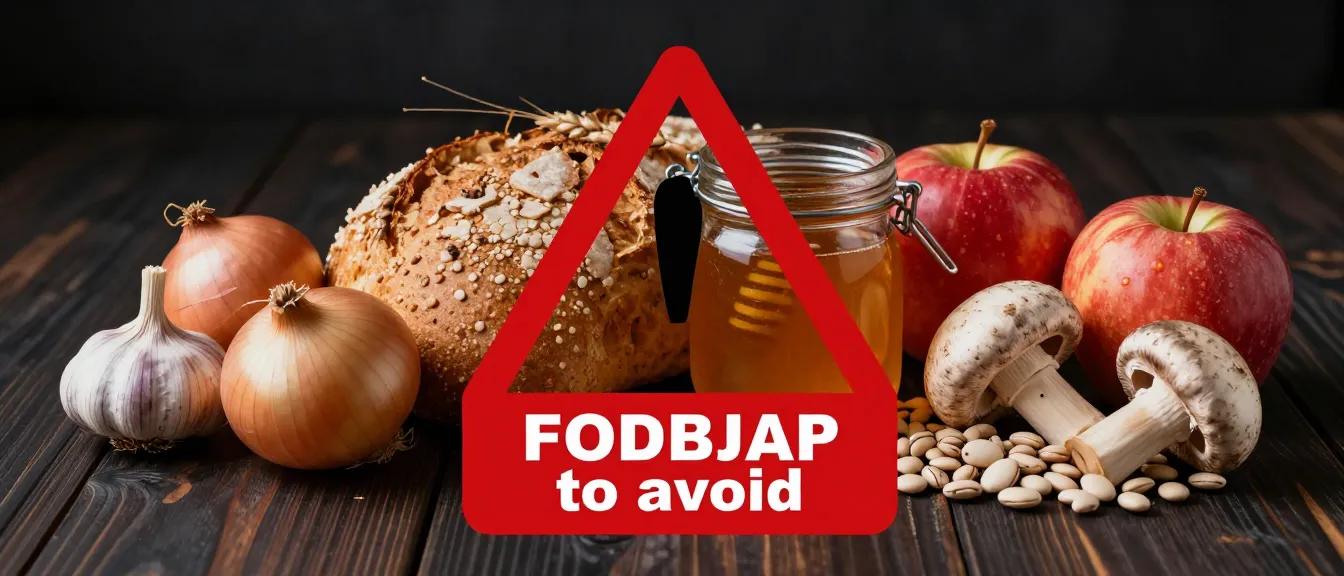
You ate a seemingly healthy salad yesterday, and spent the next four hours doubled over with cramping and bloating. The culprit wasn’t the salad itself — it was the high FODMAP ingredients hiding in it. Understanding which foods are high in FODMAPs is the key to getting through the elimination phase of the low FODMAP diet. This guide reveals exactly which foods trigger IBS symptoms, why they cause trouble, and what to eat instead.
How High FODMAP Foods Hijack Your Digestion
High FODMAP foods contain elevated levels of fermentable carbohydrates that:
- Your small intestine can’t absorb them properly
- Draw excess water into the digestive tract (osmotic effect)
- Ferment rapidly in the large intestine, producing gas
- Stretch the intestinal walls, triggering pain receptors
- Cause symptoms like bloating, gas, cramping, diarrhea, and constipation
During the 2-6 week elimination phase, avoiding these foods reduces bloating and cramping within 1-2 weeks for most people, and establishes a baseline for testing individual FODMAP groups later.
High FODMAP Foods by Category
High FODMAP Vegetables
Many vegetables contain fructans, GOS (galacto-oligosaccharides), or polyols (sugar alcohols like sorbitol and mannitol), making them problematic during elimination.
Onions and Garlic (Very High in Fructans):
- Yellow onions
- Red onions
- White onions
- Shallots
- Leeks
- Garlic (fresh, powdered, salt)
- Onion powder/salt
Why they’re problematic: Onions and garlic are among the highest FODMAP foods. As little as one clove of garlic or a tablespoon of diced onion can trigger symptoms. They’re particularly challenging because they’re used as flavor bases in countless dishes.
Alternatives:
- Garlic-infused oil (FODMAPs don’t transfer to oil)
- Green onion tops/scallion greens only
- Chives
- Asafoetida powder (Indian spice)
Cruciferous Vegetables (Fructans and GOS):
- Brussels sprouts (high in large amounts)
- Savoy cabbage (high amounts)
Alternatives:
- Broccoli (florets only, 3/4 cup)
- Regular cabbage (3/4 cup)
- Bok choy
- Green beans
Other High FODMAP Vegetables:
- Cauliflower (moderate to high depending on portion)
- Asparagus
- Artichokes
- Mushrooms (all types — high in mannitol)
- Sweet corn (in large amounts)
- Snow peas
- Sugar snap peas
- Beetroot (in large amounts)
- Fennel bulb
High FODMAP Fruits
Many fruits are high in excess fructose, sorbitol, or mannitol.
High Fructose Fruits (Excess Fructose):
- Apples
- Pears
- Mangoes
- Cherries
- Figs (fresh and dried)
- Persimmons
- Watermelon
- Boysenberries (large amounts)
Why they’re problematic: These fruits contain more fructose than glucose. When fructose isn’t balanced with glucose, your gut can’t absorb it, leading to symptoms.
Alternatives:
- Oranges
- Strawberries
- Blueberries (limited portions)
- Bananas (firm, not overripe)
- Grapes
- Kiwi
High Sorbitol Fruits (Polyol):
- Apples
- Apricots
- Blackberries (in large amounts)
- Cherries
- Nectarines
- Peaches
- Pears
- Plums
- Prunes
Why they’re problematic: Sorbitol is a sugar alcohol that draws water into the intestine and your body struggles to absorb it, causing diarrhea and bloating.
Alternatives:
- Raspberries (small amounts)
- Strawberries
- Cantaloupe
- Honeydew melon
High Mannitol Fruits:
- Watermelon
Dried Fruits (Concentrated Fructose/Sorbitol):
- Dried apples
- Dried apricots
- Dates
- Dried figs
- Prunes
- Raisins (in large amounts)
Why they’re problematic: The drying process concentrates sugars, making dried fruits much higher in FODMAPs than their fresh counterparts.
Alternatives:
- Fresh fruit in appropriate portions
- Dried cranberries (1 tablespoon)
Avocado (Polyols):
- 1/4 avocado or more is high FODMAP
- Very small amounts may be tolerated
Alternative:
- Small portions of avocado (1/8 or less)
- Olive oil as a healthy fat substitute
Already feeling overwhelmed? You don’t need to memorize all of this. Our elimination phase guide breaks the whole process into simple weekly steps. Start your elimination phase this week and use that guide alongside this list.
High FODMAP Grains & Cereals
Wheat, rye, and barley are high in fructans, while some gluten-free alternatives contain other problematic ingredients.
Wheat-Based Products (High in Fructans):
- Regular wheat bread
- Whole wheat bread
- Wheat pasta
- Wheat cereals
- Couscous
- Bulgur wheat
- Wheat crackers
- Wheat flour
- Semolina
Why they’re problematic: Wheat contains fructans, especially in larger amounts. The fermentation in sourdough bread reduces fructans, making sourdough spelt bread acceptable.
Alternatives:
- Sourdough spelt bread (2 slices)
- Gluten-free bread (check ingredients)
- Rice pasta
- Gluten-free pasta
- Rice crackers
Rye and Barley (High in Fructans):
- Rye bread
- Rye crackers
- Barley
- Pearl barley
Alternatives:
- Oats
- Quinoa
- Rice (all types)
Problematic Gluten-Free Products:
- Products with inulin/chicory root
- Products with apple juice concentrate
- Products with honey
- Products with agave
Note: Not all gluten-free products are low FODMAP! Always check ingredients. See our low FODMAP food list for safe alternatives.
High FODMAP Dairy Products
Regular dairy packs high lactose levels — a disaccharide that many people with IBS cannot digest properly.
High Lactose Dairy:
- Cow’s milk (whole, skim, 2%)
- Goat’s milk
- Sheep’s milk
- Buttermilk
- Evaporated milk
- Condensed milk
- Ice cream (regular)
- Frozen yogurt
- Milk chocolate
- Custard
Why it’s problematic: Lactose requires the enzyme lactase to digest. Many people with IBS have reduced lactase production, leaving undigested lactose to ferment in the gut.
Alternatives:
- Lactose-free milk
- Lactose-free yogurt
- Almond milk (check for additives)
- Rice milk
- Hard cheeses (naturally low lactose)
Soft Cheeses (Moderate to High Lactose):
- Ricotta cheese
- Cottage cheese
- Cream cheese (regular)
- Mascarpone
- Fresh mozzarella (in large amounts)
Alternatives:
- Cheddar
- Parmesan
- Swiss
- Brie
- Feta (small amounts)
- Lactose-free cream cheese
High Lactose Yogurts:
- Regular yogurt
- Greek yogurt (regular)
- Yogurt drinks
Alternatives:
- Lactose-free yogurt
- Lactose-free Greek yogurt
- Coconut yogurt (check for additives)
Dairy Products to Watch:
- Sour cream
- Half-and-half (in large amounts)
- Whey protein powder (unless lactose-free)
- Milk powder
High FODMAP Nuts & Seeds
While many nuts are safe in limited amounts, cashews and pistachios are high in GOS and fructans.
High FODMAP Nuts:
- Cashews (all amounts)
- Pistachios (all amounts)
Why they’re problematic: These nuts are particularly high in GOS and fructans, triggering symptoms even in a handful (around 10 nuts).
Alternatives:
- Almonds (10 nuts)
- Macadamia nuts (20 nuts)
- Peanuts (32 nuts)
- Walnuts (10 halves)
- Pecans (10 halves)
Note: Even low FODMAP nuts should be limited to recommended portions to avoid FODMAP stacking.
High FODMAP Sweeteners
Many sweeteners are high in fructose or polyols.
High Fructose Sweeteners:
- Honey (all types)
- Agave nectar
- High-fructose corn syrup
- Corn syrup
- Corn syrup solids
- Fructose
- Fruit juice concentrate
Why they’re problematic: These contain excess fructose that your gut can’t absorb, especially when consumed without glucose to aid absorption.
Alternatives:
- Maple syrup (2 tablespoons)
- Table sugar/sucrose (1 tablespoon)
- Glucose
- Pure stevia
Sugar Alcohols/Polyols (Artificial Sweeteners):
- Sorbitol (E420)
- Mannitol (E421)
- Xylitol (E967)
- Maltitol (E965)
- Isomalt (E953)
- Erythritol (in large amounts)
Why they’re problematic: Your body absorbs these poorly, and they draw water into the intestine, commonly causing diarrhea and bloating.
Alternatives:
- Sucrose (table sugar)
- Glucose
- Pure stevia
- Aspartame (if tolerated)
- Sucralose (if tolerated)
Watch For: “Sugar-free” products often contain polyols. Check labels for ingredients ending in “-ol.”
High FODMAP Legumes & Plant Proteins
Most legumes are high in GOS during the elimination phase.
High GOS Legumes:
- Beans (all types when dry or fresh)
- Chickpeas (dry or fresh)
- Lentils (dry or fresh)
- Soybeans (whole)
- Soy milk (made from whole soybeans)
- Edamame
- Hummus (made from fresh chickpeas)
Why they’re problematic: The oligosaccharides in legumes resist human digestive enzymes, so gut bacteria ferment them vigorously instead.
Alternatives:
- Firm tofu
- Tempeh (3/4 cup)
- Canned, rinsed chickpeas/lentils (small amounts, test in reintroduction)
- Soy milk made from soy protein
High FODMAP Condiments & Sauces
Many prepared sauces and condiments contain hidden FODMAPs.
Problematic Condiments:
- Ketchup with high-fructose corn syrup
- Barbecue sauce (usually contains onion, garlic, honey)
- Teriyaki sauce (often contains garlic)
- Relish (onions, high-fructose corn syrup)
- Pickles (in large amounts, garlic)
- Marinara sauce with onion/garlic
- Salad dressings with onion/garlic/honey
- Gravy (often contains onion)
- Stock/broth with onion/garlic
Why they’re problematic: These products typically combine multiple high FODMAP ingredients: onion, garlic, honey, or high-fructose corn syrup.
Alternatives:
- Make your own sauces with garlic-infused oil
- Low FODMAP certified products
- Simple oil and vinegar dressings
- Homemade marinara without onion/garlic
- Homemade stock from scratch
High FODMAP Beverages
Certain drinks can trigger symptoms due to FODMAP content or other factors.
High FODMAP Drinks:
- Chai tea (contains high FODMAP spices)
- Chamomile tea (in large amounts)
- Fennel tea
- Oolong tea (in large amounts)
- Coconut water (high in polyols)
- Apple juice
- Pear juice
- Mango juice
- Orange juice (in large amounts - more than 1 cup)
- Soft drinks with high-fructose corn syrup
- Rum (higher FODMAP than other spirits)
Why they’re problematic: These contain concentrated fructose, polyols, or high FODMAP ingredients that trigger symptoms.
Alternatives:
- Water (best choice!)
- Black tea (weak/moderate)
- Green tea
- Peppermint tea
- Ginger tea
- Coffee (limit to 3 cups)
- Wine (1 glass/150ml)
- Beer (1 bottle/375ml)
- Vodka, gin (1 shot)
High FODMAP Processed Foods
Many processed and packaged foods contain hidden FODMAPs.
Watch Out For:
- Protein bars with inulin, chicory root, dates, or honey
- Granola bars with honey, dried fruit
- Cereals with apple juice, honey, or dried fruit
- Flavored yogurts with honey or fruit
- Pre-made smoothies (often contain high FODMAP fruits)
- Sausages and processed meats with onion/garlic powder
- Breaded foods (wheat breading)
- Frozen meals with hidden FODMAPs
- Soups and broths with onion/garlic
Reading Labels: Look for these high FODMAP ingredients:
- Onion (onion powder, onion salt, onion extract)
- Garlic (garlic powder, garlic salt, garlic extract)
- Honey
- High-fructose corn syrup
- Agave
- Inulin
- Chicory root/chicory root fiber
- Fructose
- Fruit juice concentrate
- Sorbitol, mannitol, xylitol, maltitol
Common Hidden FODMAP Sources
Restaurant and Takeout Foods
Be cautious with:
- Stir-fries (garlic, onion in sauce)
- Marinades (almost always contain garlic/onion)
- Curries (onion, garlic base)
- Pasta sauces (garlic, onion)
- Soups (onion, garlic in stock)
- Burgers (onion in bun, toppings)
- Salad dressings (garlic, onion, honey)
Safer choices:
- Plain grilled proteins
- Steamed vegetables
- Rice or baked potato
- Simple salads with oil and vinegar
- Food prepared without sauces
For more tips on eating out, check our restaurant guide.
”Health Food” Products
Often contain FODMAPs:
- Protein powders (inulin, GOS, whey)
- Fiber supplements (inulin, chicory root)
- Probiotic foods (onion, garlic, honey)
- Kombucha (in large amounts)
- “Gut health” products (prebiotic fibers)
Medications and Supplements
Check for:
- Lactose (filler in many pills)
- Sorbitol (in liquid medications, lozenges)
- Mannitol (chewable tablets)
- Inulin (fiber supplements)
Your Action Plan for High FODMAP Foods
During Elimination (Weeks 1-6)
Be strict:
- Avoid all high FODMAP foods
- Read every ingredient label
- Ask about ingredients when eating out
- Use the Monash FODMAP app when unsure
During Reintroduction (Weeks 7-14+)
Test systematically:
- Reintroduce one FODMAP type at a time
- Start with small amounts
- Track your symptoms
- Identify your personal triggers
During Personalization (Long-term)
Find your balance:
- Include tolerated FODMAPs freely
- Limit poorly tolerated FODMAPs only as needed
- Eat as varied a diet as possible
- Re-test problematic FODMAPs after 6-12 months
Mistakes That Sabotage Your FODMAP Success
Mistake 1: Assuming Gluten-Free = Low FODMAP
Not all gluten-free products are low FODMAP. Many contain:
- Chicory root/inulin (fiber additive)
- Honey (sweetener)
- Apple juice concentrate (binder)
- High FODMAP flours (chickpea, amaranth in large amounts)
Solution: Always check the ingredient list.
Mistake 2: Cutting Out FODMAPs Forever
The elimination phase is temporary. Long-term restriction can:
- Reduce gut microbiome diversity
- Lead to nutritional deficiencies
- Cause unnecessary food fear
- Limit social enjoyment of food
Solution: Move through all three phases of the diet.
Mistake 3: Not Watching Portions
Even low FODMAP foods become high FODMAP in large amounts. For example, a single serving of broccoli (3/4 cup florets) is low FODMAP, but a full cup and a half crosses into high FODMAP territory.
Solution: Follow serving size guidelines and watch for FODMAP stacking.
Mistake 4: Ignoring Non-FODMAP Triggers
Other factors also affect IBS:
- Caffeine
- Alcohol
- Fatty foods
- Spicy foods
- Stress
- Lack of sleep
Solution: Address lifestyle factors alongside diet.
The Bottom Line
Knowing which foods are high in FODMAPs lets you walk into any grocery store and know exactly what to buy. Remember that elimination is temporary — the goal isn’t permanent restriction but identifying your personal triggers.
Key takeaways:
- High FODMAP foods contain fermentable carbohydrates that trigger IBS symptoms
- Onions, garlic, wheat, legumes, lactose dairy, and many fruits are high FODMAP
- Hidden FODMAPs lurk in sauces, condiments, and processed foods
- Read labels carefully and use garlic-infused oil for flavor
- After elimination, you’ll reintroduce these foods systematically
- Many high FODMAP foods may be tolerable for you in small amounts or after testing
With this list and the Monash FODMAP app, you can breeze through the elimination phase without constant second-guessing.
Start Your Elimination Phase This Week
Your first step: grab our elimination phase guide — it walks you through the entire process day by day. Need to look up a specific food fast? Use our FODMAP food database to check any food’s FODMAP rating in seconds. And when you need meal ideas that actually taste good, browse our low FODMAP recipes.
Disclaimer: This guide is for educational purposes. Individual tolerance varies. Always work with a FODMAP-trained dietitian for personalized guidance through all phases of the diet.